Why We’re Still on Strike – And What It Means for Our University Community

We want to be clear: we do not want to be on strike. We are here because we believe in protecting the quality, integrity, and future of education and research at the University of Aberdeen.

What’s really happening?

Over the past decade, academic departments have delivered strongly for the University— bringing in an additional £35 million per year to support teaching, research, and the wider institution.

At the same time, University figures show a £30 million annual decline in estate income.

Instead of addressing this imbalance, current proposals focus on cuts to teaching and staffing. These include the risk of compulsory redundancies, which would have serious consequences for staff, students, and the long-term strength of the University.

Strike action is always a last resort.

Aberdeen UCU put forward a reasonable proposal to avoid further disruption. This proposal would have:

  • Prevented compulsory redundancies for six months
  • Focused on voluntary savings instead
  • Created space for constructive, meaningful discussions

In return, we were prepared to pause strike action.

University management rejected this proposal.

That is why we find ourselves still on strike.

We understand concerns from students — and we share them.

If these proposals go ahead, they could lead to:

  • Reduced teaching capacity
  • Larger class sizes
  • Fewer courses and programme options
  • Less academic support

This is not the future we want for our colleagues, students or our University. Our action is about protecting the education we care deeply about.

We want to return to doing what we do best:
teaching, conducting research and supporting students — in a university that values both its staff and its students.

During strike action, we are continuing to engage through teach-outs — open, informal sessions where students and staff can come together to discuss the wider issues shaping higher education.

Join our teach-outs

📍 Students’ Union Building
🕐 1–3pm daily

  • Monday: Q&A with striking staff
  • Tuesday: Looking back at 1980s cuts and programme closures
  • Wednesday: Rally
  • Thursday: Trauma and Palestine
  • Friday: Scottish election & its impact on universities

These sessions are open to all—come along, ask questions, and be part of the conversation.

Students’ Union support

Aberdeen Students’ Union (AUSA) has formally supported UCU’s right to take strike action and recognises the importance of:

  • Ruling out compulsory redundancies
  • Protecting the student experience
  • Ensuring meaningful consultation across the University

We are grateful for the support shown by students, colleagues, and the wider community.

This is not just about staff — it is about the kind of university we want to be.

We remain ready to work with university senior management to find a fair and constructive way forward.

Strike action remains. What you need to know

Strikes remain on at the University of Aberdeen after management rejected a proposal from our UCU branch that could have led to action being suspended. The offer would have guaranteed that no staff would be placed at risk of redundancy for six months, with savings instead sought through voluntary means such as voluntary severance and non-staff budget reductions.


In return, we were prepared to call off the eight planned strike days and commit to no further industrial action for six months. Management rejected this proposal.
This decision puts staff livelihoods and the student experience at risk, and is a major disappointment for both staff and students. Despite delays in receiving a response, we have consistently demonstrated our willingness to engage constructively and resolve this dispute. The rejection of this proposal raises serious questions about why a resolution could not be reached, and we remain committed to opposing these plans and defending jobs.


🙏 Thank you to everyone who has engaged so far in this dispute.

We know how difficult it is to take industrial action, and we are committed to keeping members fully informed about why we are continuing.


🔍 What are our key concerns?
Following recent exchanges with SMT, here is a clear summary of the issues we have raised on your behalf:


1️⃣ Lack of meaningful consultation
We have repeatedly requested essential information, including programme-level data and modelling behind proposals. This has not been shared.
Without this, consultation cannot meet ACAS standards or allow us to properly represent members and develop alternatives.


2️⃣ Decisions being rushed without transparency
Key decisions are moving forward quickly, with inconsistent timelines.
There is also a lack of clarity about discussions with other institutions that may be shaping proposals affecting Aberdeen.


3️⃣ Risk of pre-determined redundancies
We are deeply concerned that proposed SSRs could effectively pre-select individuals or groups for redundancy.
The agreed bottom-up consultation process has not been followed, removing a key opportunity to ensure that proposals are fully informed and considered, and to avoid job losses.


4️⃣ Lack of financial justification
We have not been provided with cost-benefit analyses for the ACS proposals.
Without this, it is impossible to assess whether such major changes are necessary or proportionate.

5️⃣ Staff wellbeing concerns
Our offer to support meaningful stress risk assessments was rejected.
The assessments provided lack detail and robust action planning, raising serious concerns about staff wellbeing.


6️⃣ Threat to the character of the University
These proposals risk fundamentally changing the nature of the University as a research-intensive institution, with consequences for both staff and students.


💡 Our constructive alternatives


We have put forward serious, workable proposals to avoid compulsory redundancies:
Voluntary severance and early retirement before any compulsory measures
Partial voluntary severance options (fractional contracts)
Temporary, repayable pay deferrals
Exploring non-academic income streams and estate use
Freezing recruitment of new managers
Fairer pay structures, including salary ceilings
Supporting alternative proposals developed through Senate

These options prioritise jobs, protect the institution, and reflect sector best practice.

⚖️ Why we are continuing action?


We are now facing a situation that mirrors previous disputes:
rapid change, insufficient consultation, and staff and students expected to carry the consequences.
Industrial action is a last resort.
But without meaningful engagement from SMT, it is a necessary one.

Six Days Strong: Solidarity on the Picket Lines in Aberdeen

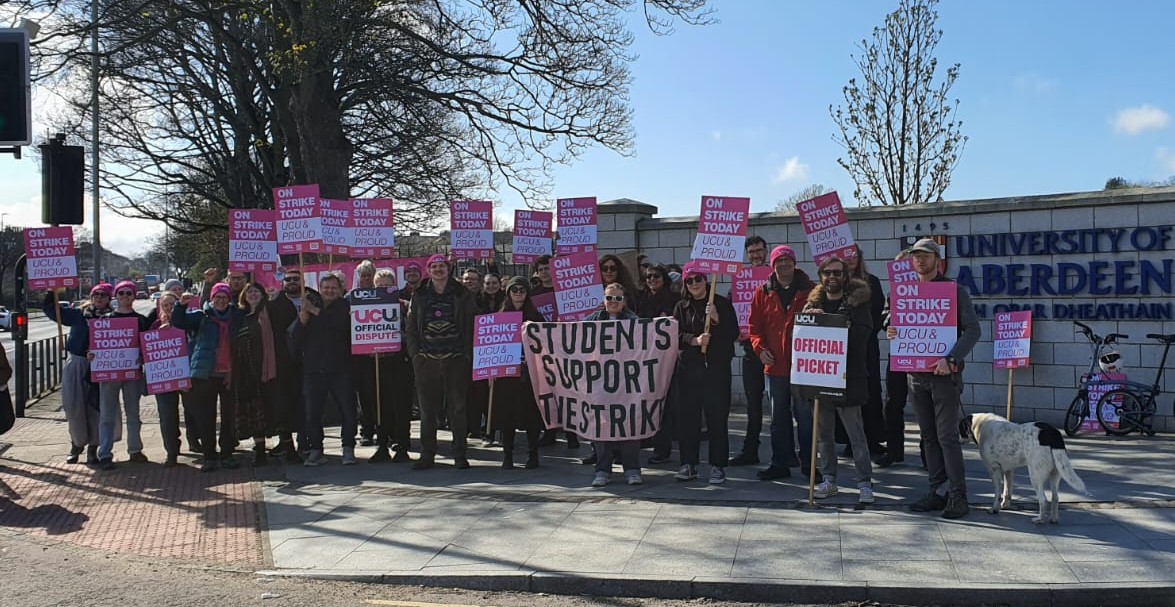
Across six days of strike action, UCU Aberdeen members have shown up with determination, energy and a powerful sense of collective purpose 🔥picture of students and staff on picket line

From early mornings in Old Aberdeen to conversations across campus, the turnout on our picket lines has been consistently strong. Each day has brought staff and students together in visible, vocal solidarity, standing up for jobs, for our colleagues and for the future of our university ✊🏾🎓

What has stood out most is the sense of community ❤️ These have not just been lines of protest, but spaces of connection. Colleagues supporting one another, students joining us in recognition of what’s at stake, and a shared commitment to protecting education and the people who make it possible.

Our action is being seen and heard 📣 The strength of participation over these six days has helped move discussions forward and ensured that our concerns cannot be ignored.

As we return to our roles teaching, researching and supporting students, we do so with that same collective spirit. The solidarity built on the picket lines continues into our everyday work.

We remain committed ✅
We remain visible 👀
And we remain together 🤝🏾

Town Hall Update: Why Staff Continue to Stand Together

At the Town Hall meeting on 11 March, the Principal claimed that progress had been made on two of the three points of dispute with UCU. He expressed that he was “deeply disappointed” that UCU had chosen to proceed with industrial action, primarily because of the impact that would have on students.

He highlighted that the management team had taken steps by beginning collective consultation with trade unions on ACS and by committing to including UCU into the organisational design workstream. He also announced that promotions had been partially unpaused.

Before examining these statements, here’s a reminder of the three core issues at stake:

· The lack of meaningful consultation on ACS

· The pause on promotions for academic staff

· The refusal to rule out compulsory redundancies

staff & Students on picket outside University of Aberdeen

pic- Klaudia Mazur

1. Meaningful consultation on ACS: still missing

Despite being the largest union on campus, representing academics and academic-related and professional services (ARPS) staff on grades 5 and above, UCU was initially excluded from all ACS workstreams. Only after considerable pressure was one UCU member permitted to join a single workstream, Governance and Leadership, about a month ago.

There have now been two occasions where management handpicked a union representative. This fundamentally misunderstands, and frankly disrespects, the democratic principles on which unions operate. Unions select their own representatives. Anything else undermines the legitimacy of the process.

And despite a stated “commitment” to include UCU in the remaining workstreams, we only received a request to collectively nominate ONE representative to the Academic and Professional Services workstreams on 13 March. Meanwhile, senior management has indicated that decisions on ACS (including how many members of staff will lose their jobs) will be taken at the next Court meeting on the 29th of April.

We have only a matter of weeks to influence workstreams that have been running for months and whose outcomes appear to be already determined. Because when management insist that final decisions will not be made until Court meet, that is simply semantics. SMT will be presenting fully developed recommendations for Court to approve, and those recommendations will not be shaped by last-minute feedback.

The Principal emphasised SMT’s desire to listen to as many “diverse voices” across the university community as they can. They say they are keen to engage with trade unions and hear our “creative ideas”. Yet, they provide us with neither the time nor the information necessary to offer them.

Instead, they have already announced major changes to student-staff ratios and programme closures – changes that will deeply affect the student learning experience. And according to analyses such as the Scottish Parliament report “The impact of tightening finances on Scotland’s universities” (published on the 24th February), such cuts may actually worsen the University’s financial position over time, as well as harm our surrounding region, driving us into a downward spiral.

This is not what meaningful consultation looks like.

2. Academic promotions: a partial and problematic ‘unpause’

Management’s proposal is to unpause previously submitted promotions only up to and including Senior Lecturer (so only for Grades 6 and 7), leaving many existing applications in limbo for even longer. The Principal argued that promotions have budget implications beyond the current financial year. Of course they do! Promotions are based on an individual’s performance and long-term contributions against a set of criteria, not short-term budget cycles. A robust budgeting model should already account for this. It is concerning that a recurrent ‘aspiration’ for both the old guard and the new guard of SMT has been to ensure promotions can run every year, and yet they have failed to develop a budgeting model that can reliably support them.

It’s also important to recognise that academic staff must demonstrate performance at the level for which they are applying before they are promoted. In practice, a lecturer ‘acts’ as a senior lecturer long before any formal recognition. Meanwhile, senior managers who ‘act up’ receive immediate remuneration for their additional responsibilities. Staff whose promotions have been ‘paused’ are, in effect, involuntarily subsidising the University through unpaid higher-level labour. It’s the worst type of regressive taxation!

Failing to have a robust budgeting model effectively turns academic promotions into something resembling the ARPS regrading system, driven by “business need” rather than professional merit. ARPS colleagues have long asked to move from regrading toward a proper promotions framework. But instead of making progress for ARPS staff, the University is dragging academics backwards. It feels less like a strategy and more like a race to the bottom.

Even more concerning, management suggested to UCU that unpausing some promotions might require additional savings elsewhere. Given their repeated emphasis on staff costs as the University’s largest expenditure, UCU members understandably see this as reinforcing our concern: compulsory redundancies remain firmly on the table.

3. Compulsory redundancies: still not ruled out

The University’s own Annual Report shows cash holding has increased, so the University has enough cash for another round of payouts. Despite repeated requests, the Principal continues to refuse to rule out compulsory redundancies. So, we need only read between the lines to understand the true intent.

So where does that leave us?

The Principal said SMT has done what it can to address the different elements of the dispute and the ball is now with UCU. But UCU members are clear that, unfortunately, the steps taken so far are insufficient to justify any de-escalation of industrial action. The point was made very clearly by the turnout at Thursday’s picket line, the largest in many years.

On one point, however, we agree wholeheartedly with the Principal: we, too, are disappointed to be on strike. Strike action is never taken lightly and it is always a last resort. We are deeply aware of the impact on students, and we care about that. This is why staff on strike are organising ‘teach-outs’ on Tuesday and Wednesday in collaboration with the Students’ Union. But the impact of the planned cuts will do lasting harm to the quality of education and research, and to the students’ experience. Strikes occur only when every attempt to engage constructively has been exhausted.

And while we lose pay during each strike day (a serious hardship for many UCU members), the alternative is far worse. For many of us, what is at stake is not a few days’ salary, but our long-term livelihoods. And those who will remain employed face the prospect of even more unsustainable workloads. The University already runs on the goodwill and sustained commitment of overworked and underpaid staff (both academics and professional services).

Continuing in this direction is simply unsustainable: the cost of inaction will be higher than the cost of striking. This is why UCU members continue to stand together. Solidarity!

Aberdeen UCU Strike: Student FAQ

Aberdeen UCU Strike: Student FAQ

When are the strikes?

Staff at the University of Aberdeen will strike on:

  • Thursday 12 March 2026

  • Friday 13 March 2026

  • Tuesday 17 March 2026

  • Wednesday 18 March 2026

Some teaching and services may be disrupted on these days.


Why are staff striking?

Staff are taking action over planned budget cuts and the threat of compulsory redundancies.
The union is calling on the university to protect jobs and rule out forced job losses.


What does this mean for students?

Staff working conditions are students’ learning conditions.

Job cuts and increased workloads risk:

  • larger classes

  • reduced course options

  • less support for students

  • pressure on teaching quality


Are staff paid while on strike?

No. Staff lose pay for every day they strike, so industrial action is taken as a last resort.


What are “teach-outs”?

We may be on strike, but we still love teaching and learning.

Striking staff will be organising teach-outs on topics they care about. These are free informal sessions open to students, staff, and the wider community.

Look out for announcements on strike days about when and where teach-outs will take place.

Beginner’s Guide to Going on Strike

Strike Action: What You Need to Know

Strike action is one of the most powerful tools we have as a union. When we act together, we show the University that staff are united in defending colleagues, jobs, and the future of our institution.

Every member who takes part strengthens our collective voice.


When Is the Strike Taking Place?

Strike days:

22 April- 1 May

These are our moments to demonstrate unity, determination, and the seriousness of this dispute.


What Do I Do on a Strike Day?

It’s simple: do not go to work.

If you are striking, you should not carry out any university work whatsoever, including:

  • Teaching

  • Meetings

  • Emails

  • Marking

  • Administrative duties

You do not need to notify your manager or complete a form beforehand.

Just do not attend work.

If you can, come and join colleagues on the picket line.


✊ How Do I Join a Picket Line?

Picket lines are a visible show of solidarity — and a great way to support each other.

  • Pickets will be at the main entrances to Old Aberdeen.

  • You can also go to Dunbar Hall, where coordinators will direct people to picket locations needing extra support.

Picketing runs from early morning until around lunchtime.

You can join at any time — staying even for an hour helps.

Dunbar Hall will be open 07:30–11:30 as a warm space with coffee and a place to connect with colleagues.


Will I Get Paid if I’m on Strike?

Strike action means withdrawing your labour, so the employer will normally deduct pay for strike days.

However, support is available:

  • Aberdeen UCU Hardship Fund – for members on the lowest incomes

  • National UCU Fighting Fund – support for members losing pay due to industrial action

Full details on how to apply will be circulated shortly.


How Do I Stay Updated During the Strike?

You may not have access to your university email while striking.

We have created a UCU WhatsApp channel for updates on:

  • Strike logistics

  • Picket locations

  • Negotiations

  • Any urgent developments

A link to join will be sent to all members.


Not a Member Yet? Join UCU Today

Become a member here:

https://www.ucu.org.uk/join

Joining strengthens our collective position and ensures you are fully supported during the dispute.


Every Member Matters

Your participation is vital.

Together we show that staff at the University of Aberdeen are committed to defending jobs, colleagues, and the future of our university.

We look forward to seeing many of you on the picket line.